Thursday, June 08, 2006

Terwyl dit by ons koud is...


Ice Skating - Medieval Style!

The capital's ice rinks are nothing new - Londoners have been skating since the 12th Century on rather unusual skates...

Somerset House is just one of many amazing ice rinks to be found in London this year but ice skating in the capital is nothing new. A new exhibition, Medieval London, includes a pair of ice skates dating back to the Medieval times.

The skates, made from cattle bones, have been found around the Moorfields area of the city. They would have been strapped to the feet as Londoners took to the frozen marshes using a special stick to glide across the ice.

Skaters either lost their skates or threw them away at the end of the season where they have since been discovered. The marshy earth helps to preserve the bone for so long .
William FitzStephen, one of Thomas Becket's clerks, described in the 1170s how Londoners would go out to the frozen marshes of Moorfields in the winter. They 'fit to their feet the shinbones of cattle and push themselves across the ice using a stick with an iron spike on the end'

'When the great marsh that washes the Northern walls of the City is frozen, dense throngs of youths go forth to disport themselves upon the ice. Some gathering speed by a run, glide sidelong, with feet set well apart, over a vast space of ice. Others make themselves seats of ice like millstones and are dragged along by a number who run before them holding hands. Sometimes they slip owing to the greatness of their speed and fall, everyone of them, upon their faces'.

So how far back do teenage yobs and binge drinking go? What did Londoners feel about the worst epidemic the city has ever known? Where did London go for 200 years? And who bought all those hot sheep’s feet? The answers to these and other questions can be found in the Museum of London’s new Medieval London gallery opening on 25 November.The gallery tells the story of London from the end of Roman rule in AD410 to the accession of Elizabeth I in 1558, a period when London survived near extinction to become England’s capital and one of the most prosperous cities in Europe.

Wednesday, June 07, 2006

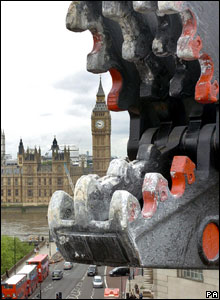
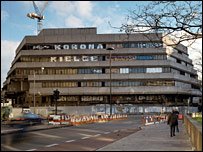
Demolition work begins on eyesore


Six-year-old Harrison Richards launched the demolition workOne of London's most hated eyesores is being razed to the ground to make way for a £300m luxury hotel.

The vast concrete County Hall Island Block apartments on the South Bank next to Waterloo station belonged to the now-defunct Greater London Council.

Having stood empty for 20 years, the block, built in 1970, is to be demolished over the next four months.

By 2010, Westminster Bridge Park Plaza will rise 14 storeys high to overlook Big Ben and the Houses of Parliament.

I am absolutely devastated - I consider that it was a distinguished building
John Bancroft, architect

The job of setting the bulldozers in motion fell to six-year-old Harrison Richards, from Oakley Green in Berkshire.

He lives with Wilms Tumour, a cancer of the kidney, and was granted his wish by the charity, Make-a-Wish Foundation UK.

Last year, the six-floor block was named as the 11th ugliest building in Britain by a poll for Channel 4 programme Demolition, coming two places behind London's highest entry, the Tower in Colliers Wood in south-west London.

But despite its lack of popularity, it seems not everyone will be happy to see No 1 Westminster Bridge Road go.

Architect John Bancroft, who formerly worked for the Greater London Council, said the block should have been listed. "I am absolutely devastated," he said. "I consider that it was a distinguished building and it was an early open plan office building, when open plan was not all that common.

"I always thought it should have received a listing in with County Hall."

Storie en foto's van BBC

Monday, June 05, 2006

Welkom terug, Pieter & Anca!

Nog is dit (Diana se) einde niet!


Di-ondersoek ’n slag vir Al-FayedJun 04 2006 09:33:12:240PM - (SA)

Mandy Rossouw

Londen. – Prinses Diana van Wallis was nóg swanger nóg verloof aan Dodi al-Fayed ten tyde van haar dood in Parys in 1997.

Lord John Stevens, die voormalige polisiehoof wat aangestel is om die besonderhede van Diana se dood in ’n motorongeluk in ’n Paryse tonnel te ondersoek, sê glo in sy verslag geen bewys bestaan dat die prinses swanger was nie.

Hy het bygevoeg die juwelier wat glo aan Dodi en Diana haar verloofring verkoop het, is weer ondervra en hy het erken die verloofring van £2 miljoen (sowat R25 miljoen teen die huidige wisselkoers) het nooit bestaan nie.

Stevens se verslag word eers later vanjaar bekend gestel, maar het aan die Mail on Sunday en News of the World uitgelek.

Die onthullings plaas mnr. Mohamed al-Fayed, eienaar van die luukse winkel Harrods en pa van Dodi, in ’n verleentheid nadat hy sedert die ongeluk volgehou het die voorval is die werk van sinistere magte.

Al-Fayed sr. meen die ongeluk is beplan deur Britse intelligensiemagte soos MI5 en MI6.
Hy sê Diana was swanger met Dodi se kind en die Britse koningsgesin wou nie ’n baba in hul midde hê wat “half-Moslem” is nie. Hy het prins Philip, koningin Elizabeth II se man, die skuld vir die ongeluk gegee en gesê die prins sou enigiets doen om te keer dat prins William ’n halfbroer het wat ’n Moslem is.

Volgens Al-Fayed is die ongeluk beplan en die paparazzi wat Diana en Dodi die aand van die ongeluk agtervolg het, was spioene.

Volgens Stevens se ondersoek dui niks op die betrokkenheid van MI5 en MI6 nie.

Dodi en Diana sou luidens sy verslag waarskynlik die ongeluk oorleef het indien hulle veiligheidsgordels gedra het.

Die ondersoek het bevestig dat mnr. Henri Paul, die bestuurder van die Mercedes-Benz waarin hulle gery het, dronk én te vinnig gery het en beheer oor die motor verloor het. Hy was nie, soos Al-Fayed beweer, ’n spioen wat met die intelligensiedienste saamgewerk het nie.

Wednesday, May 31, 2006

Philip, the Duke of Hazard

Philip, the Duke of Hazard 30/05/2006 09:19 - (SA)

David Stringer

London - Britain's Prince Philip had not caused offence when he claimed he intends to do "as little as possible" during the 2012 Olympic Games in London, event organisers said on Monday.
The comments came days before publication of a book, which catalogues the prince's history of making verbal gaffes.

The husband of Queen Elizabeth II, who turns 85 on June 10, said he finds Olympic opening and
closing ceremonies "absolute bloody nuisances," in comments attributed to him in an interview with Britain's Daily Telegraph newspaper.

Asked if he intended to perform duties during the 2012 Olympics, by which time he will be 91, the prince told the newspaper he hoped to do "as little as possible".

Ceremonies 'absolute bloody nuisances'

A spokesperson for the Queen's Buckingham Palace residence said the prince had granted the interview before his birthday and confirmed she had no reason to doubt the authenticity of the comments.

"I am truly fed up with the opening and closing ceremonies. They are a pain in the neck," Prince Philip told the newspaper, in an interview first published in Saturday editions.

"Opening and closing ceremonies ought to be banned. Absolute bloody nuisances. I have been to one that was absolutely, appallingly awful," he told the newspaper.

Jackie Rock-Doyle, London 2012 chief spokesperson, said the comments were a "good thing" and would only serve to raise public interest, according to a statement.

"The great thing about the Olympic and Paralympic Games is that pretty much everyone has a view - from the Royal Family down," she said.

Collection of gaffes

The prince's latest barb came before the publication on Wednesday of The Duke of Hazard: The
Wit and Wisdom of Prince Philip, a book that celebrates six decades of his blunt - and often politically incorrect -comments during engagements across the world.

The 100-page book includes details of an infamous gaffe in Beijing, China in 1986, when the prince told British students "if you stay here much longer you'll all be slitty-eyed".

It also recounts an occasion in Cardiff, Wales, when he addressed young members of the British Deaf Association who were standing close to a band playing steel drums. "Deaf? If you are near there, no wonder you are deaf," the prince told them.

In Hungary, the prince is said to have told a British man he must have only arrived recently as he hadn't "got a pot belly" and in Scotland, asked a driving instructor how he managed to "keep the natives off the booze long enough" to pass their driving test.

Authors Phil Dampier and Ashley Walton and the book's publisher Book Guild Limited were not immediately available for comment.

"We are aware of the book, but it is matter for the authors," said the Buckingham Palace spokesperson, speaking on customary condition of anonymity.

Tuesday, May 30, 2006

New York


Pieter verjaar vandag in New York. Anca het vir hulle 'n helikoptertrippie na (en om) Manhattan bespreek... lekker bederf ;-)

Geniet jou verjaarsdag, Boeta!

New York City

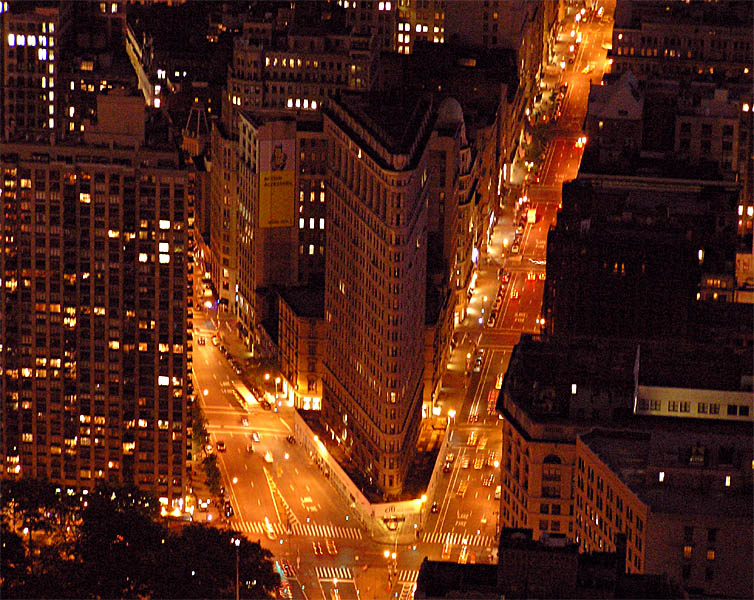
New York, the ‘city that never sleeps’, is one of the world’s great metropolises, offering visitors everything from the ethnic flavors of Chinatown and Little Italy, to the galleries of SoHo, the cafes of Greenwich Village, the glitz of the Theater District, the shopping on Fifth Avenue and the affluence of Park Lane and the Upper West Side.

New York City is made up of five boroughs and is laid out on a grid of avenues and streets. Most tourist sights are found on Manhattan Island, the city’s entertainment and business center. The remaining four boroughs are primarily residential – the Bronx to the north, Queens to the east, Brooklyn to the southeast and Staten Island to the southwest. Each has wealthy and salubrious districts alongside working-class neighborhoods – demonstrating New York’s varied social mix. The total area of all five boroughs is 780 sq km (301 sq miles).

New York’s location at the mouth of the Hudson River on the Atlantic Ocean is reflected in the city’s importance as a port, and as the point of disembarkation for millions of immigrants to the USA. Vibrating with the energy of over 7 million inhabitants, New York is a constantly evolving, growing and changing organism.

The sheer volume of things to do – theater, ballet, opera, museums – is astonishing. Many of the city’s 18,000-plus restaurants are reporting boom times, while several new hotels have emerged over the past few years. Renovations of historic theaters in the area – such as the Victory, the Lyric or the Academy/Apollo – have been followed by a flood of restaurateurs and prospective retail tenants signing up for space on or near Times Square.

The terrorist attacks on Manhattan’s famous Twin Towers on 11 September 2001 has had a detrimental effect on the city’s tourism. However, New York’s JFK airport still enjoys its status as the USA’s busiest airport for international arrivals, with over 15 million international tourists (many of them from the UK) using the airport in 2002. On the whole, however, numbers are down, with Newark International and La Guardia reporting a 4 per cent and 6 per cent decrease in international arrivals respectively. Crime, on the other hand, is plummeting, following the introduction of ‘zero tolerance’ policing; according to FBI crime statistics, the city is the safest large city in the USA.

The New York City Police Museum, at 100 Old Slip at South Street, shows just how this is done. Visitors with disabilities will now find wheelchair access to 99 per cent of New York City buses and 40 per cent of subway stations. Public telephones for the deaf are also widespread. Two brochures for disabled people are available from New York City Transit (see contact number above).

Manhattan

The Manhattan skyline is an instantly recognizable sight, immortalized in countless films and television programs. One of the best views of it can be obtained from the Staten Island Ferry (see below).

Following the terrorist attacks of 11 September 2001, the famous landmark of the World Trade Center with its twin towers was completely destroyed, forever altering both the skyline and the history of America. The decision has recently been made to build a memorial at the ‘Ground Zero’ site. The Lower Manhattan Development Corporation announced in January 2004 that Michael Arad and Peter Walker’s design for a grove of trees above two reflecting pools, named ‘Reflecting Absence’, would be chosen to immortalise that infamous event. The design was chosen over 5000 submitted ideas. Also in the planning is the ambitious Freedom Tower skyscraper, designed by David M Childs, which could have a unique turbine tower as a feature, creating one-fifth of the energy used by the building and doubling as somewhat unorthodox Buddhist prayer wheels.

The first European settlement on Manhattan was by the Dutch in the 1620s, who named the city New Amsterdam. In 1664, the British took over and renamed it New York, and settlement continued from south to north along the island. Skyscrapers, such as the art-deco Empire State Building, offer spectacular views of the city by day or night. Statue of Liberty and Ellis Island: New York’s most famous image is the 46.5m- (151ft-) high Statue of Liberty, located on Liberty Island, which may be reached by boat from Battery Park on Manhattan’s southern tip. A lift and staircase inside the Statue take visitors up to an observation platform.

The Liberty/Ellis Island Ferry departs from the historic Castle Clinton at Battery Park every 30 minutes and also stops at Ellis Island, the gateway for the massive numbers of immigrants arriving in New York between 1892 and 1954. On the island, the Wall of Honor, the world’s longest wall of names, commemorates over 600,000 immigrants, and the Ellis Island Immigration Museum offers an interesting insight into the lives of New York’s early immigrants.

In Battery Park City, the new Skyscraper Museum celebrates the architectural style so intrinsic to the city’s history and psyche. Lower Manhattan: The oldest part of the city is at the southern end of Manhattan. East of Battery Park is the Financial District, containing the famous Wall Street and the New York Stock Exchange, where visitors have access to a public gallery to catch a glimpse of the frenetic trading action. The historic South Street Seaport, located at the end of Wall Street, offers great views of New York Harbor. The seaport is a thriving waterfront community with a world-class maritime museum and more than 100 shops, cafés and restaurants.

To the northeast of the seaport is the famous Brooklyn Bridge, leading to Brooklyn. Chinatown, Manhattan’s most thriving ethnic neighborhood extends from Canal Street into Little Italy and east into the Lower East Side. This labyrinth of narrow streets, crammed with Chinese stores and restaurants, is home to over 100,000 residents.

While Chinatown has expanded in recent years, neighboring Little Italy has dwindled somewhat, and few of the original Italian immigrants remain, though Little Italy’s restaurants, delis and bakeries remain as tempting as ever.

East of Little Italy, the Lower East Side has traditionally been New York’s Jewish area, owing to a flow of Jewish immigrants to the area in the late 19th and early 20th centuries. The recently revamped Museum of Jewish Heritage is located here. In addition to its other two Manhattan venues, the Guggenheim Foundation is adding a new waterfront museum on the East River. The area is also known for its Orchard Street Market, an open-air bazaar, and its numerous delis.

To the northwest, Greenwich Village has been a melting pot for art, literature and music for decades, though its legendary bohemian feel has partly been replaced by upmarket beatnik chic. South of Greenwich Village is SoHo (South of Houston), which has become synonymous with art since the 1960s, and retains its arty, avant-garde character, with plenty of galleries, cafes, boutiques and loft spaces fronted by interesting cast-iron façades.

Still further south is TriBeCa (Triangle Below Canal Street), once a deserted warehouse district, and now a growing residential area. Midtown Manhattan: The heart of the city is located between 34th Street south and 59th Street north and contains several of New York’s landmark buildings, including the 102-story Empire State Building (completed in 1931).

Worth visiting here are Bryant Park and the beautiful New York Public Library nearby; the 1930s art-deco Chrysler Building (New York’s first skyscraper); the United Nations Building (the organization’s world headquarters); Grand Central Station, which has been completely restored, with special attention paid to its magnificent constellation ceiling; Fifth Avenue, the city’s most glamorous thoroughfare, filled with luxury shops and department stores; the Chelsea neighborhood, home of the landmark Chelsea Hotel and also center for New York’s gay community as well as a new magnet for art galleries and commercial developers; the Rockefeller Center, famous for its (winter-only) ice skating rink and also the home of NBC Studios, which can be visited (the Center reopened its observation deck in 2005, website: http://www.www.rockefellercenter.com/) and the new American Folk Art Museum.

A few blocks away, the highly celebrated Museum of Modern Art underwent a massive US$650 million expansion, which was completed in spring 2004. The Carnegie Hall now also includes the Judy and Arthur Zankel Hall. At the heart of Midtown is the Broadway theater district near the recently revamped, once seedy but now ‘family-friendly’ Times Square, with its recently reopened Biltmore Theater, and the world’s largest toy store, home to a 60ft Ferris wheel and life-size Barbie house. Uptown Manhattan: Uptown Manhattan covers the area north of 59th Street and is split roughly in the middle by Central Park (see below).

To the northwest of the park is Columbia University and the Cathedral of St John the Divine, the world’s largest Gothic cathedral, which is still under construction (begun in 1812); the cathedral was recently designated a landmark by the New York City Landmark Preservation Commission. The new US$115 million Jazz at Lincoln Center opened in autumn 2004; the venue is part of the new AOL Time Warner Center, which contains luxury retail outlets, restaurants, office space, condominiums and a 249-room hotel. The Alvin Ailey American Dance Theater also opened its new facility in autumn 2004. The Joan Weill Center for Dance will be the largest facility dedicated exclusively to dance in the USA. Further north, Harlem is noted for its rich African-American community. Good examples of classic New York brownstones can be seen in Harlem’s Sugar Hill. Several decayed and crime-ridden areas in Harlem are now being redeveloped.

Brooklyn

Brooklyn is best reached via Brooklyn Bridge, which is particularly striking at night, and usually bustling with people during the day. Having crossed the bridge, visitors arrive in Brooklyn Heights, a good area to walk around.

The Jewish Children’s Museum is a new attraction to the area. Further southeast lie Prospect Park and the adjacent Brooklyn Botanic Gardens; the Brooklyn Academy of Music, home to the interesting Next Wave Festival; and the historic Park Slope district, notable for its old brownstones. Downtown Brooklyn is home to the recently renovated New York Transit Museum, located in a decommissioned subway station, with over 200 trolleys on display.

Coney Island and Brighton Beach, the latter full of Russian shops and restaurants, are at the south/southeastern end of the borough.

The Bronx

Major attractions include the world-famous Bronx Zoo and New York Botanical Garden; Yankee Stadium, home to the Yankees baseball team; Poe Cottage, former home of the writer Edgar Allan Poe; and Woodlawn Cemetery, where several famous musicians, including Miles Davis, are buried. This area of New York is currently good at breaking records.

The 19,200-seat Randall’s Island Pavilion opened in May 2003 and was the first major new live stage venue to be built in the city in 30 years, while the Ferry Point Park Golf Course, designed by Jack Nicklaus, will open later this year as the first golf course to be built in the city for 35 years.

Queens

Major attractions in the borough include the Astoria Movie Studios with the (attached) American Museum of the Moving Image, close to La Guardia airport; and Shea Stadium (home to the New York Mets Major League Baseball team), with the nearby Flushing Meadows-Corona Park.

The southern half of Queens includes a portion of the Gateway National Recreation Area which, despite its location next to JFK International Airport, provides a refuge to hundreds of bird species.Staten IslandVisitors to the island often do so mainly to enjoy the view of the classic New York skyline from the Staten Island Ferry, which operates from Battery Park (downtown) past the Statue of Liberty and Ellis Island to Staten Island.

The Verrazano-Narrows Bridge connects Staten Island with Brooklyn.Parks & BeachesNew York’s most famous park, Central Park, was created in 1856, when officials set aside 341 hectares (843 acres) of land between Fifth and Eighth Avenues and 59th and 110th Streets. John Lennon fans may pay their respects at Strawberry Fields, the area of the park dedicated to his memory. Also within the park is the Central Park Wildlife Center, a small but interesting zoo.

During summer, the park hosts afternoon and evening concerts. Additions to the park include the Dana Discovery Center and fishing pond (with free poles and bait). Visitors should note that it is not advisable to visit Central Park after dark. The recently restored Bryant Park, behind the New York Public Library, has been a great success with businesspeople and visitors on lunch, especially as it offers free outdoor concerts and comedy shows.

Reminiscent of Paris, with gravel pathways, green folding chairs and a manicured lawn, it’s a great place for sunbathing, reading or enjoying a sandwich or salad bought from kiosks in the park. The fountain at the western end is a good place for a romantic rendez-vous.

Other parks include the world-famous New York Botanical Garden in the Bronx, which has 100 hectares (250 acres) of woods, waterways and gardens and whose centerpiece is the newly restored Enid A Haupt Conservatory. Riverside Park, running alongside the Hudson River; Battery and Washington Square parks in Lower Manhattan; the Brooklyn Botanical Gardens, Marine Park and Prospect Park in Brooklyn; and Cunningham, Flushing Meadows/Corona, Jacob Riis and Kissina parks in Queens. Clove Lake Park and Fort Wadsworth on Staten Island boast impressive views of New York harbor.

There are several fine beaches to the east of New York City. Nearest to Manhattan are Brighton Beach, Coney Island and Manhattan Beach. Other beaches include Orchard Beach in Pelham Bay Park, South Beach and Wolfe’s Pond Park on Staten Island.

Special Events

The following is a selection of special events occurring in New York City in 2005; for further events, contact NYC & Company CVB (see General Info section): Mar 17 St Patrick’s Day Parade, Manhattan. Jun-Aug Celebrate Brooklyn Performing Arts Festival, Brooklyn. Jul 4 Macy’s 4th of July Fireworks, near East River. Aug Harlem Week, citywide. Aug 29-Sep 11 US Open Tennis Tournament, Flushing. Nov 6 New York City Marathon. Nov 24 Macy’s Thanksgiving Day Parade, Manhattan. Dec 31 New Year’s Eve at Times Square.

Pieter verjaar (in die stad wat nooit slaap nie)!


Highlights in history on this date:

1431 - After being handed over by the church, who judged her a heretic, Saint Joan of Arc is burned at the stake in Rouen, France, by the English and their French collaborators.

1539 - Spanish explorer Hernando De Soto lands in Florida.

1588 - Spanish Armada under Duke of Medina sails from Lisbon for England.

1593 - Playwright Christopher Marlowe is killed in a lodging house brawl outside London.

1606 - Sikh Guru Arjun is tortured to death in Lahore - now part of Pakistan - on the orders of Mughal Emperor Jahangir, becoming Sikhism's first martyr.

1808 - France's Napoleon Bonaparte annexes Tuscany in Italy.

1814 - First Treaty of Paris is signed between European countries and France, ending Napoleonic wars until the return of Napoleon from exile on Elba.

1904 - Japanese forces occupy Dalmy (Darien) in Russia.


1911 - Ray Harroun wins the first long-distance auto race in Indianapolis.

1913 - Turkey loses almost all of its European holdings to the Balkan states in a treaty signed in London, ending the First Balkan War.

1925 - British police kill 13 demonstrators in Shanghai, provoking months of demonstrations and boycotts against British goods in China. The incident greatly bolsters the tiny Communist party.

1942 - British convoy reaches Murmansk, Soviet Union, despite heavy air attacks in World War II; Britain's Royal Air Force stages massive raid on Cologne, Germany.

1943 - American forces secure the Aleutian island of Attu from the Japanese during World War 2.

1957 - Britain relaxes its restrictions on trade with China.

1958 - Unidentified US soldiers killed in World War 2 and the Korean conflict are buried at Arlington National Cemetery in Virginia.

1961 - Rafael Trujillo, dictator of Dominican Republic, is assassinated by machine-gun fire while driving.

1963 - Official death toll in windstorm that struck East Pakistan is put at 10 000.

1967 - Egypt's President Gamal Abdel Nasser and Jordan's King Hussein sign a mutual defence treaty, prompting Israel to strike pre-emptively a week later, starting the Six-Day War.

1973 - West Germany and Czechoslovakia agree to establish normal relations after 32 years.

1976 - Pieter Grobbelaar is born in Kimberley, South Africa

1982 - Spain becomes Nato's 16th member, the first country to enter the Western alliance since West Germany in 1955.

1984 - Iraq reports new attacks on naval target near Iran's Kharg Island oil port.

1987 - Mob of militant low-caste villagers massacre at least 42 members of upper-caste landlord families in India's impoverished eastern state of Bihar.

1989 - Student demonstrators at Tiananmen Square in Beijing erect a 10m statue they called the "Goddess of Democracy".
1990 - Israeli soldiers kill four Palestinian guerrillas and capture 12 as they speed toward the coastline, apparently to launch attacks coinciding with Jewish holiday of Shavuot.

1991 - Car bomb explodes near Civil Guard barracks in Vic, Spain, killing at least nine people and injuring 50.

1992 - The UN Security Council imposes trade sanctions on Serbia and Montenegro.
1993 - Heavy machine gun and artillery fire booms in Kabul, Afghanistan, as rival Muslim guerrilla factions shatter a weeklong truce.

1994 - Israel releases hundreds of Palestinian prisoners as part of its autonomy agreement with the PLO.

1995 - Russia formalises a broad relationship with Nato but warns anew that the alliance's plans for an eastward expansion could divide Europe.

1996 - Venezuela's Supreme Court convicts former president Carlos Andres Perez of misusing public funds.

1997 - US Marines evacuate 900 civilians from Freetown, the capital of Sierra Leone, wracked by looting and violence after a military coup; child molester Jesse K. Timmendequas is convicted and sentenced to death in Trenton, New Jersey, for raping and strangling a 7-year-old neighbour, Megan Kanka. The 1994 murder inspired "Megan's Law," requiring that communities be notified when sex offenders move into the neighbourhood.

1998 - A powerful earthquake rocks northern Afghanistan, burying entire villages and killing thousands of people.

1999 - Fifty-two teen-agers are trampled to death as they try to escape a sudden hailstorm that interrupted an outdoor rock concert in Minsk, Belarus.

2000 - Moving to end Fiji's leadership crisis, the country's army commander imposes martial law and begins to isolate the rebels who have been holding the prime minister and other government officials hostage.

2001 - In one of Germany's last trials surrounding World War 2, a court sentences to life in prison Anton Malloth, an 89-year-old former Nazi SS guard, for beating and kicking a Jewish inmate to death.

2002 - New York City commemorates the completion of a 37-week cleanup effort at the site of the World Trade Centre, destroyed in the terrorist attacks, signalling the beginning of the rebuilding process.

2003 - The UN Security Council votes unanimously to send a peacekeeping force to Congo's northeastern Ituri province. The European Union approves the force to restore order and security in a region plagued by violence among ethnic militias.

2004 - Israel's nuclear whistleblower Mordechai Vanunu says in an interview that the Israeli invasion of Lebanon in 1982 influenced his decision to tell the world about his country's secret nuclear military programme.

Today's Birthdays:

Mikhail Bakunin, Russian anarchist (1814-1876); Howard Hawks, US film director (1896-1977); Hannes Alfven, Swedish astrophysicist/Nobel Prize laureate (1908-1995); Mel Blanc, US entertainer (1908-1989); Benny Goodman, US musician (1909-1986); Clint Walker, actor (1927--); Wynonna, US country singer (1964--), Pieter Grobbelaar (1976-)

Thought For Today:

To write or to speak is almost inevitably to lie a little. It is an attempt to clothe an intangible in a tangible form; to compress an immeasurable into a mold. And in the act of compression, how truth is mangled and torn! - Anne Morrow Lindbergh, American writer.

Sunday, May 28, 2006

Die London Stone word (tydelik) verskuif

London Stone Relic Moves to Museum From Sport Shop, BBC Reports2006-05-22 10:21 (New York)

By Sarah Das May 22 (Bloomberg) -- A legendary stone, reported to have thepower to protect London, will be relocated from a sports shop inthe city's financial district when the building is demolished laterthis year, the British Broadcasting Company reported.

The stone of Brutus, whose origins are unknown, is said tokeep London safe so long as it survives, the broadcaster said.

It was displayed on the side of St. Swithin church until thebuilding was destroyed in World War II bombing. It was then stuckin a cage on the wall of the building that replaced it, a sportsshop in Cannon Street. The best view of the stone is from thecricket department, the BBC said. The limestone block will be stored in the Museum of Londonwhile the site is renovated and back on display outside the newbuilding, the BBC reported.

(BBC Online 05-22)

To contact the reporter on this story:Sarah Das in London at (44) (20) 7673-2638 or sdas4@bloomberg.net

To contact the editor responsible for this story:Chris Collins in London at (44) (20) 7330-7902 orcollinsc@bloomberg.net

Die Britse Ryk krimp (en nee, dis nie omdat Pieter en Anca in NY is nie)

British Empire Shrinks by Two Soccer Fields With Bangkok Sale2006-05-16 02:15 (New York)
By Lee J. Miller May 16 (Bloomberg)

-- The British Empire shrank by theequivalent of two soccer fields this week, with Thailand'sbiggest retail developer buying a chunk of embassy land in theheart of Bangkok for more than 3 billion baht ($78 million).

The 12.75-acre compound ``was larger than needed,'' theBritish embassy said in a statement. A 3.55-acre section ofgardens was sold to a unit of the closely held Central Group,which will develop the site.

A war memorial and statue of Queen Victoria will be movedoff the plot bought by Central, which already owns a seven-storydepartment store 100 meters down the road and is developingThailand's largest retail, office and convention center a half amile farther down the street -- Bangkok's shopping heartland. ``This is the largest-ever property sale by the ForeignOffice,'' the embassy said. Money not spent on refurbishment andnew staff housing will ``pay for vital investment elsewhere.'' Neither Central nor the embassy would disclose the price,citing a confidentiality clause. Local newspapers including theBangkok Post and The Nation said the price was between 3 billionand 3.5 billion baht. Britain's Telegraph said it was 50 millionpounds ($94 million). The embassy did say that 11 million poundswould be used for refurbishment. Britain bought the property in 1922. At the time, it was inthe outskirts of the Thai capital, which has since sprawled intoa metropolis with more than 10 million people.

`Most Polluted Part'

``The land sold was the most polluted and noisiest part ofthe compound, next to a six-lane arterial road,'' the embassysaid. Central Retail Corp. spokeswoman Wanna Thamromdee wasn'tavailable to confirm the price or provide details of how theproperty would be developed. The price per acre was probably a record for Thailand,according to Colin Wong, associate director at Knight FrankChartered (Thailand) Co. Land & Houses Pcl, Thailand's largesthome builder, was the other bidder.

``There is a limited amount of prime commercial sites inBangkok, so one of the main reasons is just a lack of supply,''Wong said in an interview today. ``Central will probably havebetter return calculations than other people, and it complementstheir existing store next door.''

Never Colonized

CB Richard Ellis (Thailand) Co. handled the sale, saidNgamjai Jearrajarat, the company's spokeswoman. Thailand was never part of the British Empire, and mostgovernment-written profiles point out that the nation, known asSiam until 1939, is the only one in Southeast Asia that wasn'tcolonized. Malaysia to the south and Burma, which forms most ofThailand's western border, were both part of the British Empire. Central is owned by the Chirathivat family, one ofThailand's wealthiest. The investment was through its TiangChirathivat Real Estate Co. Ltd., not the family's main listedunit, Central Pattana Pcl. Tiang Chirathivat is the name of Central Group's founder,who started the multibillion-dollar empire in 1947 when heopened a general merchandise store importing luxury goods fromoverseas. His sons and grandchildren manage the group withassets including the KFC fast food franchise, Central PlazaHotel Pcl, a stake in retailer Big C Supercenter Pcl, and amajor share of the Bangkok Post, Thailand's biggest circulationEnglish-language newspaper.

To contact the reporter on this story:Lee J. Miller in Bangkok at (66) (2) 654-7306 orlmiller@bloomberg.net

To contact the editor responsible for this story:Beth Jinks in Bangkok at (66) (2) 654-7314 orbjinks1@bloomberg.net

Barking mad?

U.K. Council to Teach Pet Owners to Speak `Dog,' Telegraph Says2006-05-17 04:23 (New York)

By Toby Anderson May 17 (Bloomberg) -- A U.K. local authority is offeringpet owners free lessons to talk ``dog'' as it seeks to fightagainst nuisance barking, the Daily Telegraph reported, citingofficials. Peterborough City Council will, with the help of theDepartment for Environment, Food and Rural Affairs, teach dogowners to understand the meaning of their pets' barking, thenewspaper said.

Owners will be taught to distinguish betweenbarking that signifies, for example, territoriality andattention seeking, frustration and wanting to play.

About 15 percent of the 1,4000 complaints that the city'snoise pollution team receives on average each year involve dogsbarking, according to the report. Across the U.K. that figure is even higher, with about one quarter of complaints involving dognoise.

The lessons will include advice from a dog behaviorist, avet, and a head nurse who will explain why dogs bark and whatthey are saying, the Telegraph reported.

(Daily Telegraph 5-17 p3)
For the Daily Telegraph's Web site, click {TGRF }

To contact the reporter on this story:Toby Anderson in London at (44) (20) 7673 2695 ortanderson7@bloomberg.net

To contact the editor responsible for this story:Chris Collins at (44) (20) 7330 7902 orcollinsc@bloomberg.net.

Pieter en Anca is in die Groot Appel

Net betyds vir ... Memorial Day!

Memorial Day, originally called Decoration Day, is a day of remembrance for those who have died in our nation's service. There are many stories as to its actual beginnings, with over two dozen cities and towns laying claim to being the birthplace of Memorial Day. There is also evidence that organized women's groups in the South were decorating graves before the end of the Civil War: a hymn published in 1867, "Kneel Where Our Loves are Sleeping" by Nella L. Sweet carried the dedication "To The Ladies of the South who are Decorating the Graves of the Confederate Dead" (Source: Duke University's Historic American Sheet Music, 1850-1920 <http://memory.loc.gov/ammem/award97/ncdhtml/hasmhome.html> ). While Waterloo N.Y. was officially declared the birthplace of Memorial Day by President Lyndon Johnson in May 1966, it's difficult to prove conclusively the origins of the day. It is more likely that it had many separate beginnings; each of those towns and every planned or spontaneous gathering of people to honor the war dead in the 1860's tapped into the general human need to honor our dead, each contributed honorably to the growing movement that culminated in Gen Logan giving his official proclamation in 1868. It is not important who was the very first, what is important is that Memorial Day was established. Memorial Day is not about division. It is about reconciliation; it is about coming together to honor those who gave their all.
<http://www.usmemorialday.org/images/logan4a40426r.jpg>

Memorial Day was officially proclaimed on 5 May 1868 by General John Logan, national commander of the Grand Army of the Republic, in his General Order No. 11 <http://www.usmemorialday.org/order11.html> , and was first observed on 30 May 1868, when flowers were placed on the graves of Union and Confederate soldiers at Arlington National Cemetery. The first state to officially recognize the holiday was New York in 1873. By 1890 it was recognized by all of the northern states. The South refused to acknowledge the day, honoring their dead on separate days until after World War I (when the holiday changed from honoring just those who died fighting in the Civil War to honoring Americans who died fighting in any war). It is now celebrated in almost every State on the last Monday in May (passed by Congress with the National Holiday Act of 1971 ( P.L. 90 - 363) to ensure a three day weekend for Federal holidays), though several southern states have an additional separate day for honoring the Confederate war dead: January 19 in Texas, April 26 in Alabama, Florida, Georgia, and Mississippi; May 10 in South Carolina; and June 3 (Jefferson Davis' birthday) in Louisiana and Tennessee.

In 1915, inspired by the poem "In Flanders Fields," <http://www.usmemorialday.org/backgrnd.html#1> Moina Michael replied with her own poem:

We cherish too, the Poppy red
That grows on fields where valor led,
It seems to signal to the skies
That blood of heroes never dies.

She then conceived of an idea to wear red poppies on Memorial day in honor of those who died serving the nation during war. She was the first to wear one, and sold poppies to her friends and co-workers with the money going to benefit servicemen in need. Later a Madam Guerin from France was visiting the United States and learned of this new custom started by Ms.Michael and when she returned to France, made artificial red poppies to raise money for war orphaned children and widowed women. This tradition spread to other countries. In 1921, the Franco-American Children's League sold poppies nationally to benefit war orphans of France and Belgium. The League disbanded a year later and Madam Guerin approached the VFW for help. Shortly before Memorial Day in 1922 the VFW became the first veterans' organization to nationally sell poppies. Two years later their "Buddy" Poppy program <http://www.vfw.org/index.cfm?fa=cmty.levelc&cid=127> was selling artificial poppies made by disabled veterans. In 1948 the US Post Office honored Ms Michael for her role in founding the National Poppy movement by issuing a red 3 cent postage stamp <http://www.usmemorialday.org/backgrnd.html#2> with her likeness on it.

Traditional observance of Memorial day has diminished over the years. Many Americans nowadays have forgotten the meaning and traditions of Memorial Day. At many cemeteries, the graves of the fallen are increasingly ignored, neglected. Most people no longer remember the proper flag etiquette for the day. While there are towns and cities that still hold Memorial Day parades, many have not held a parade in decades. Some people think the day is for honoring any and all dead, and not just those fallen in service to our country.

There are a few notable exceptions. Since the late 50's on the Thursday before Memorial Day, the 1,200 soldiers of the 3d U.S. Infantry place small American flags at each of the more than 260,000 gravestones at Arlington National Cemetery. They then patrol 24 hours a day during the weekend to ensure that each flag remains standing. In 1951, the Boy Scouts and Cub Scouts of St. Louis began placing flags on the 150,000 graves at Jefferson Barracks National Cemetery as an annual Good Turn, a practice that continues to this day. More recently, beginning in 1998, on the Saturday before the observed day for Memorial Day, the Boys Scouts and Girl Scouts place a candle at each of approximately 15,300 grave sites of soldiers buried at Fredericksburg and Spotsylvania National Military Park on Marye's Heights (the Luminaria Program <http://www.nps.gov/frsp/luminari.htm> ). And in 2004, Washington D.C. held its first Memorial Day parade in over 60 years.

To help re-educate and remind Americans of the true meaning of Memorial Day, the "National Moment of Remembrance<http://www.usmemorialday.org/speeches/president/may0200.txt> " resolution was passed on Dec 2000 which asks that at 3 p.m. local time, for all Americans "To voluntarily and informally observe in their own way a Moment of remembrance and respect, pausing from whatever they are doing for a moment of silence or listening to ' Taps <http://www.usmemorialday.org/taps.html> ."

The Moment of Remembrance is a step in the right direction to returning the meaning back to the day. What is needed is a full return to the original day of observance. Set aside one day out of the year for the nation to get together to remember, reflect and honor those who have given their all in service to their country.

But what may be needed to return the solemn, and even sacred, spirit back to Memorial Day is for a return to its traditional day of observance. Many feel that when Congress made the day into a three-day weekend in with the National Holiday Act of 1971, it made it all the easier for people to be distracted from the spirit and meaning of the day. As the VFW stated in its 2002 Memorial Day address: "Changing the date merely to create three-day weekends has undermined the very meaning of the day. No doubt, this has contributed greatly to the general public's nonchalant observance of Memorial Day."

On January 19, 1999 Senator Inouye introduced bill S 189 to the Senate <http://www.usmemorialday.org/act.html#bill> which proposes to restore the traditional day of observance of Memorial Day back to May 30th instead of "the last Monday in May". On April 19, 1999 Representative Gibbons introduced the bill to the House ( H.R. 1474). The bills were referred the Committee on the Judiciary and the Committee on Government Reform.
Sign the Petition <http://www.thepetitionsite.com/takeaction/994208286>
in support of bill S 189

To date, there has been no further developments on the bill. Please write your Representative <http://www.house.gov/house/MemberWWW.html> and your Senators <http://www.senate.gov/contacting/index.cfm> , urging them to support these bills. You can also contact Mr. Inouye <http://www.senate.gov/~inouye/webform.html> and Mr. Gibbons <http://wwwc.house.gov/gibbons/contact_feedback.asp> to let them know of your support.

Friday, May 26, 2006

Die Ierse familie


Danksy ons Ierse oupa, kan ons ook Iere word. Hier is Benoit (ons nefie) saam met Jessy (die Ierse tannie).

Denis O'Leary (die Ierse oupa) sou Sondag verjaar het.

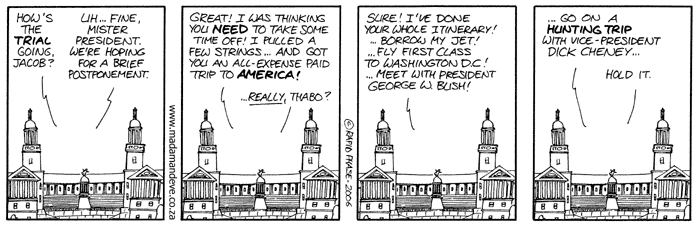
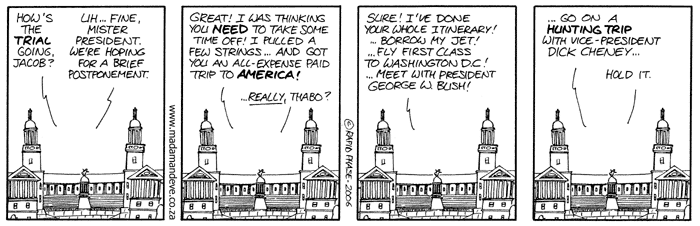
Jacob Zuma was ook amper Amerika toe...


...volgens Madam & Eve!

In die spore van Mbeki ;-)

Wednesday, May 24, 2006

Nou wag Lady Liberty...


...anderkant die aarde! Pieter en Anca vlieg Saterdag, maar spook nog tussendeur met werk, huisreparasies en eksamens!

Tuesday, May 23, 2006

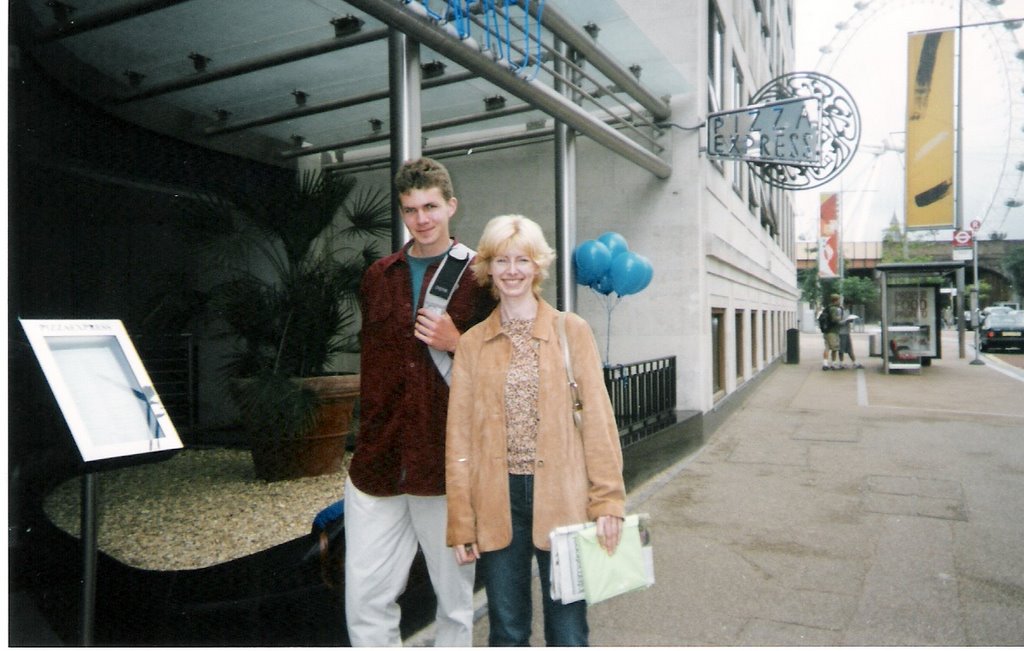
Pieter se eerste bestemming buite London... Dover!

Dover

Dover is ‘n belangrike kanaal-hawe in Kent. Dover is bekend vir haar wit kranse, wat uit kalk bestaan. Hierdie kranse het Brittanje die bynaam Albion besorg, dit beteken "wit". Die dorp se naam kom van die Brutoonse woord Dubrās ("die water"). Die Franse noem dit Douvres, uitgespreek [duv].

Die feit dat dit so naby aan Europa is – dis maar 34 kilometer van die Franse hawe, Calais – maak Dover een van die Verenigde Koninkryk se besigste kanaal-hawens. Ongeveer 18 miljoen passasiers gaan jaarliks deur die dorp. Daar is gereelde ferries tussen Dover en Calais en Dunkerque. Daar is ook ‘n catamaran diens na Boulogne.


Geskiedenis

Dover is al vir millennia ‘n belangrike hawe.

Brons-tydperk

In 1992 is ‘n boot wat uit die bronstydperk dateer op ‘n diepte van 6 meter ontdek. Dis een van die oudste seevaartuie wat ooit ontdek is. Die boot dateer (volgens koolstof-analises) uit ongeveer 1550 voor Christus.

Die Langdon Bay hoard, wat in 1974 aan die kus by Dover ontdek is, het brons akse van Franse oorsprong aan boord gehad. Dit sou daarop kon dui dat die handeldrywery oor die kanaal terugdateer tot in die bronstydperk. Die bote kan word uitgestal in die Dover Museum op die Markplein.

Romeinse tydperk

In die Romeinse tye het die dorp ‘n gefortifiseerde hawe, Portus Dubris, geword. Dover was die beginpunt van die Watling Straat Romeinse pad.

Ongeveer AD 50 het die Romeine twee ligtorings gebou, een aan elke kant van die destyse rivier. Een staan nog steeds binne die gronde van die Dover Kasteel, dis een van die oudste geboue in Brittanje. Die "Painted House" is a Roman vesting uit ongeveer AD 200 en een van die bes bewaarde Romeinse huise in Brittanje.

Anglo-Sakse

In die Anglo-Saksiese tye is ‘n fort gebou. Dit was die eerste deel van wat later Dover Kasteel sou word. In 1216, is Dover deur die Franse aangeval en suksesvol verdedig deur Hubert de Burgh.

20ste Eeu

Die Duitsers het Dover gereeld aangeval tydens die Eerste Wêreldoorlog.

Monday, May 22, 2006

The Simpsons as philosophy


Pieter se gunsteling comic? Die Simpsons... en nou het dit blykbaar intellektuele waarde ;-)

The Simpsons is more than a funny cartoon, it reveals truths about human nature that rival the observations of great philosophers from Plato to Kant... while Homer sets his house on fire, says philosopher Julian Baggini.

With the likes of Douglas Coupland, George Walden and Stephen Hawking as fans, taking the Simpsons seriously is no longer outre but de rigeur.

It is, quite simply, one of the greatest cultural artefacts of our age. So great, in fact, that it not only reflects and plays with philosophical ideas, it actually does real philosophy, and does it well.
How can a comic cartoon do this? Precisely because it is a comic cartoon, the form best suited to illuminate our age.

To speak truthfully and insightfully today you must have a sense of the absurdity of human life and endeavour. Past attempts to construct grand and noble theories about human history and destiny have collapsed.

We now know we're just a bunch of naked apes trying to get on as best we can, usually messing things up, but somehow finding life can be sweet all the same. All delusions of a significance that we do not really have need to be stripped away, and nothing can do this better that the great deflater: comedy.

The satirical cartoon world is essentially a philosophical one because it reflects reality by abstracting it, distilling it and presenting it back to us, illuminating it more brightly than realist fiction can The Simpsons does this brilliantly, especially when it comes to religion. It's not that the Simpsons is atheist propaganda; its main target is not belief in God or the supernatural, but the arrogance of particular organised religions that they, amazingly, know the will of the creator.
For example, in the episode Homer the Heretic, Homer gives up church and decides to follow God in his own way: by watching the TV, slobbing about and dancing in his underpants.
Throughout the episode he justifies himself in a number of ways.

"What's the big deal about going to some building every Sunday, I mean, isn't God everywhere?"

"Don't you think the almighty has better things to worry about than where one little guy spends one measly hour of his week?"

"And what if we've picked the wrong religion? Every week we're just making God madder and madder?"

Homer's protests do not merely allude to much subtler arguments that proper philosophers make. The basic points really are that simple, which is why they can be stated simply.

Philosophy's First Family

Of course, there is more that can and should be said about them, but when we make decisions about whether or not to follow one particular religion, the reasons that really matter to us are closer to the simple truths of the Simpsons than the complex mental machinations of academic philosophers of religion.

And that's true even for the philosophers, whose high-level arguments are virtuosi feats of reasoning, but are not the things that win hearts and minds. They are merely the lengthy guitar solos to Homer's crushing, compelling riffs.

However, being simple is not the same as being simplistic, which is one of the greatest crimes in the Simpsons' universe.

We can see this when Homer's house catches fire, in what could be seen as divine retribution for his apostasy.

But what actually led to the fire was not God's wrath but Homer's hubris and arrogance. Sitting on his sofa thinking smugly, "Boy, everyone is stupid except me," he falls asleep, dropping his cigar.

What really caused the fire was thus a slippage from the simple into the simplistic. Homer's mistake was to think that because the key points which inform his heresy are simple, that the debate is closed and he has nothing left to learn from others. But this is being simplistic, not keeping things simple.

Small dots, big picture

Revealing simple truths about simplistic falsehoods is not just a minor philosophical task, like doing the washing up at Descartes' Diner while the real geniuses cook up the main courses.
For when it comes to the relevance of philosophy to real life, all the commitments we make on the big issues are determined by considerations which are ultimately quite straightforward.

Pointillist paintings, such as this by Seurat, use thousands of tiny dotsA rich philosophical worldview is in this sense like a pointillist picture - one of those pieces of art in which a big image is made up of thousands of tiny dots (see Seurat image, right). Its building blocks are no more than simple dots, but the overall picture which builds up from this is much more complicated.
Yet we need reminding that the dots are just dots, and that errors are made more often not by those who fail to examine the dots carefully enough, but those who become fixated by the brilliance or defects of one or two and who fail to see how they fit into the big picture.
And the Simpsons certainly plays out on a broad canvas.

Any individual or group is shown to be ridiculous when only their pathetic and partial view of the world is taken to be everything. That's why no one escapes satire in programme, which is vital for its ultimately uplifting message: we're an absurd species but together we make for a wonderful world.

The Simpsons, like Monty Python, is an Anglo-Saxon comedic take on the existentialism which in France takes on a more tragic hue. Albert Camus' absurd is defied not by will, but mocking laughter.

Abstract themes
Another reason why cartoons are the best form in which to do philosophy is that they are non-realistic in the same way that philosophy is.

True heir to Plato, Simpsons creator Matt GroeningPhilosophy needs to be real in the sense that it has to make sense of the world as it is, not as we imagine or want it to be. But philosophy deals with issues on a general level. It is concerned with a whole series of grand abstract nouns: truth, justice, the good, identity, consciousness, mind, meaning and so on.

Cartoons abstract from real life in much the same way philosophers do. Homer is not realistic in the way a film or novel character is, but he is recognisable as a kind of American Everyman. His reality is the reality of an abstraction from real life that captures its essence, not as a real particular human who we see ourselves reflected in.

The satirical cartoon world is essentially a philosophical one because to work it needs to reflect reality accurately by abstracting it, distilling it and then presenting it back to us, illuminating it more brightly than realist fiction can.

That's why it is no coincidence that the most insightful and philosophical cultural product of our time is a comic cartoon, and why its creator, Matt Groening, is the true heir of Plato, Aristotle and Kant.

Van Dover na New York


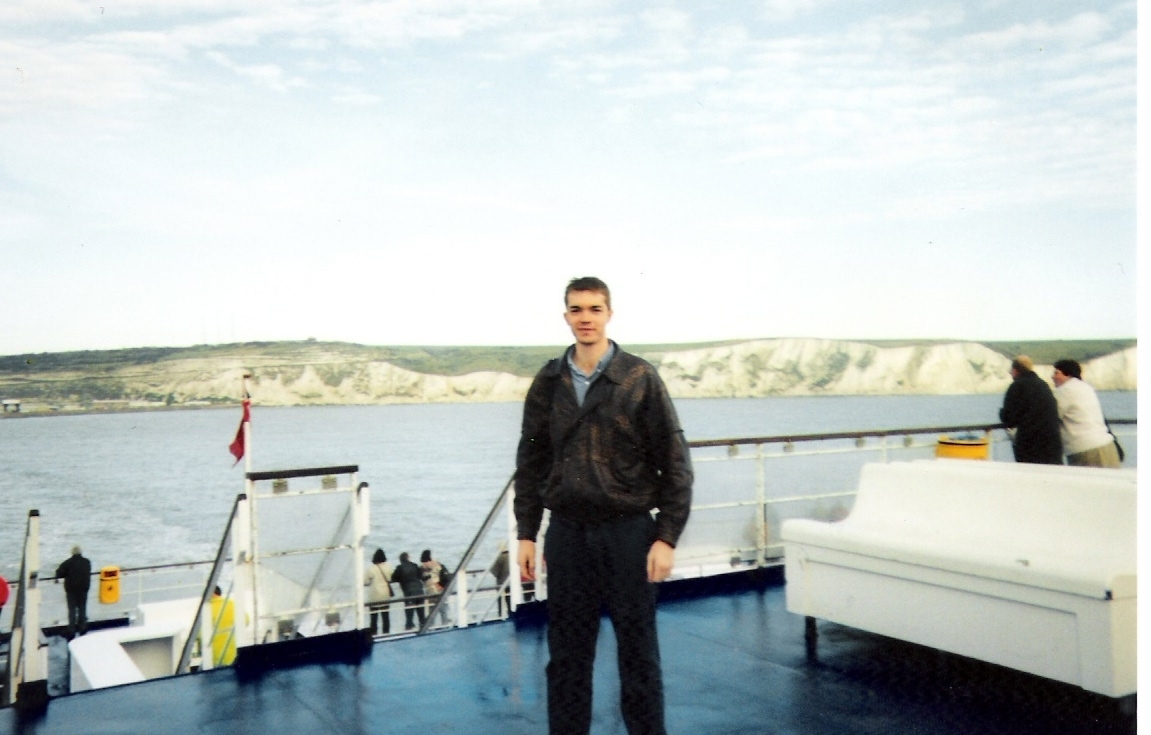
Hier is Pieter op sy eerste trippie uit London uit. Hy het met die bus gery tot in Dover en van daar met die ferry na Frankryk. Die trippies is ook bekend as 'booze cruises', want die belasting net oor die kanaal op alkohol, sigarette en sjokolade is baie laag en dan gaan koop die Britte so.

Hierdie naweek (27/5/2006) vlieg hy en Anca New York toe. Daar was darem 'n paar trippies tussnin waarvan ek later meer sal vertel.

Thursday, May 18, 2006

Toe Pieter London toe is...

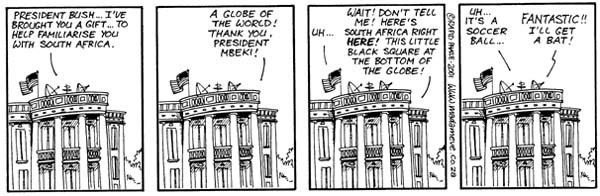
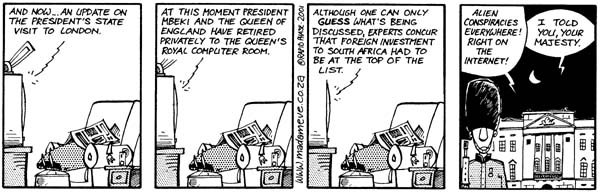
... het dit (vir my) gevoel of die hele land agter hom aan is. Hy het Chris Barnard ontmoet in Harrods. Chris Barnard het Pieter se kopie van sy boek geteken.

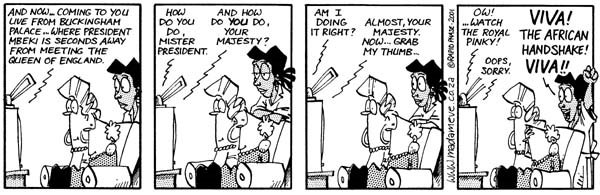
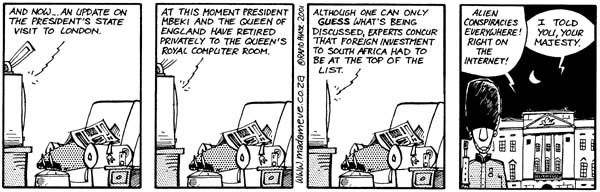
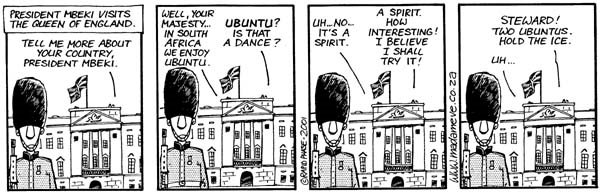
Ons president was ook daar! Hier is die Madam en Eve strokies van 5 jaar gelede...


Airbus A380 makes first UK visit


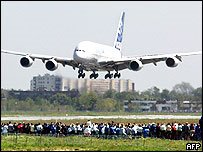
The A380 made its first flight in April 2005Aviation history will be made in London as the world's biggest passenger jet touches down at the world's biggest international airport.

The 555-seat Airbus A380 will fly from Berlin to Heathrow for its first UK visit, after taking a minor detour.

The 240ft long plane will dip its wings as it flies over the Airbus sites that designed and made them, at Broughton in North Wales and Filton, near Bristol.

It will undergo compatibility tests at Heathrow before flying out on Friday.

Aviation milestone

Heathrow operator BAA is spending £450m so that it is ready to handle the A380 when it starts making commercial flights later this year.

It's an efficient and clean and environmentally friendly aircraft, and it has lower fuel consumption per seat, and produces less noise and emissions than older aircraft.

The aircraft will be met at the airport's new £105m pier 6 at Heathrow's Terminal 3, and money has also been spent resurfacing runways, upgrading lighting and building new taxiways.
Developed by the European Airbus consortium for about £6bn, the A380 has been heralded as a major milestone in aviation history.

The jet maker has taken 159 firm orders for the plane from 16 carriers, including Singapore Airlines, which will make the inaugural commercial flight on its route between Sydney, Singapore and London later this year.

Airports Council International represents the world's airport operators and its spokesman, David Gamper, told BBC Radio Five Live: "It's an efficient and clean and environmentally friendly aircraft, and it has lower fuel consumption per seat, and produces less noise and emissions than older aircraft, and for airports it should increase their ability to handle passengers."